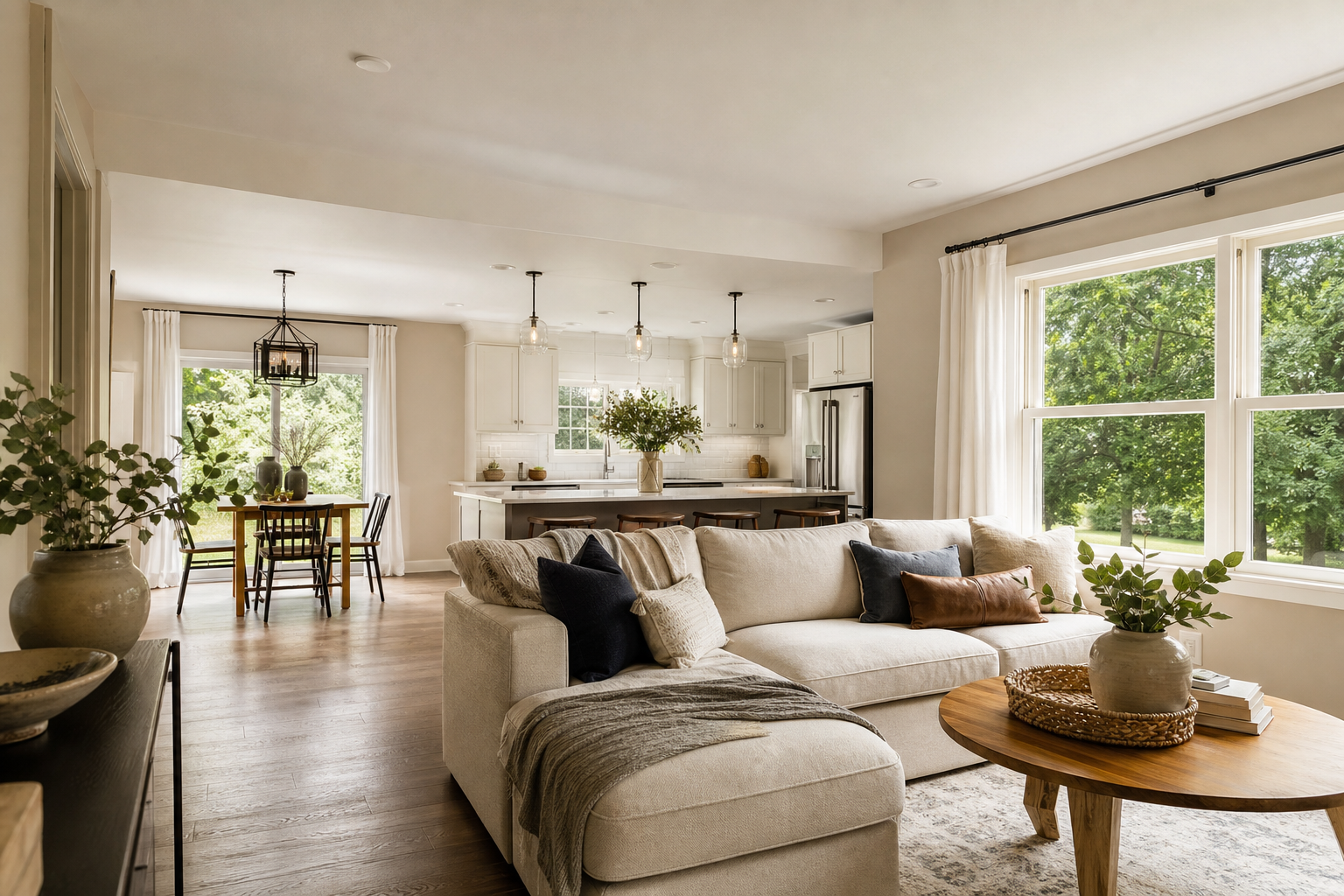
How will the Voorhees Town Center redevelopment affect nearby home values?
The Voorhees Town Center redevelopment is converting the former Echelon Mall site at Route 561 and Somerdale Road into a walkable, mixed-use downtown core for the township, with residential, retail, office, and civic uses. National research from the Urban Land Institute and regional case studies consistently find that well-executed town-center projects raise surrounding residential values and improve long-term price resilience, though the magnitude depends on execution quality, tenant mix, and broader market conditions. As of August 2026, the project is an ongoing, multi-phase effort, and its full impact on Voorhees property values is still unfolding.
What the Voorhees Town Center Project Actually Is
Voorhees has been a classic South Jersey bedroom community for decades. Most residents commute to Philadelphia, Camden, or Cherry Hill for work, then come home to quiet subdivisions built largely from the 1970s onward. The township has never had a true downtown. That is exactly what the Town Center redevelopment is designed to create.
The Voorhees Township redevelopment plan, adopted by ordinance, formally designates the former Echelon Mall site as a Town Center Redevelopment Area. The plan calls for a mix of retail, office, residential, civic, and public space, all organized around pedestrian connectivity rather than parking lots. The township’s own municipal complex has already relocated to the site, a meaningful signal that this is not just a developer’s vision on paper.
Recent news coverage from 2024 and 2025 describes active negotiations for further phases, including reconfiguration of underperforming retail space and additional residential and mixed-use components. This is a long-term, multi-phase effort, not a single ribbon-cutting moment. Buyers and investors evaluating Voorhees today are essentially making a bet on where this project lands five to ten years from now.
The Commute Factor
One reason Voorhees holds its value is access. The township sits in Camden County, connected to Philadelphia via the PATCO Speedline (the Ashland station is a short drive away), Route 73, Route 561, I-295, and the NJ Turnpike. For buyers who work in Center City Philadelphia or the Camden waterfront, Voorhees competes directly with Cherry Hill, Marlton, and Mount Laurel on commute time. A more walkable, amenity-rich town center strengthens that competitive position.
What the Research Says About Mixed-Use Redevelopment and Home Values
I want to be honest here: no one can guarantee that a specific redevelopment project will lift your home’s value by a specific amount. What the research does tell us is directional and worth understanding before you make an offer.
The Urban Land Institute has documented case studies of suburban mall-to-town-center conversions nationally, including projects like Belmar in Lakewood, Colorado, and Santana Row in San Jose. The pattern in successful projects is consistent: adding residential units, public space, and structured parking connected to regional transit produces positive spillover effects on nearby single-family home values. Projects that stall, sit half-empty, or attract low-quality tenants produce the opposite.
Congress for the New Urbanism case studies on Northeast and Mid-Atlantic mall redevelopments reinforce this: successful projects increase surrounding residential sales prices and support new multifamily construction. The key word is “successful.” Execution matters enormously.
Research on walkable urbanism from Smart Growth America finds that U.S. metro areas where more households have access to walkable mixed-use centers tend to see higher average home values and stronger long-term price growth, controlling for income and other factors. Voorhees is not starting from zero here. It already has strong fundamentals.
The Voorhees Fundamentals Right Now
According to the most recent data available as of August 2026, the South Jersey housing market has been performing well. New Jersey Realtors® Q2 2025 regional reports show year-over-year price appreciation across Southern New Jersey, including Camden County, with median sale prices above pre-2020 levels and continued buyer demand despite elevated mortgage rates. Camden County’s median home sale price in calendar year 2024 was higher than in 2023, and early 2025 monthly snapshots from New Jersey Realtors® show tight months of supply and relatively quick days on market, pointing to a seller-leaning market as of that period.
That said, market conditions change. Those figures reflect a specific point in time, and I always tell buyers to verify current conditions with a local market analysis before making decisions based on older data.
Voorhees also has strong demographic underpinnings. U.S. Census Bureau American Community Survey data (most recently updated through 2024 releases) shows Voorhees Township with a relatively high median household income compared to Camden County overall, a large proportion of owner-occupied housing, and significant commuter flows to Philadelphia. Those are the conditions that support durable housing demand.
| Factor | Voorhees Situation | Why It Matters for Values |
|---|---|---|
| Town Center redevelopment | Active, multi-phase; municipal complex already relocated | Adds walkable amenities; broadens local tax base over time |
| PATCO access | Ashland station nearby; direct to Philadelphia | Expands buyer pool; commuter demand supports prices |
| Camden County market trend | Year-over-year appreciation through 2024-2025 (NJ Realtors®) | Baseline demand remains strong entering 2026 |
| Local employment anchors | Virtua Voorhees hospital; healthcare and professional offices | Stable local employment supports housing demand |
| Property tax environment | NJ taxes are high statewide; mixed-use development may broaden tax base | Buyers should factor annual tax bills into affordability |
What Buyers Should Actually Watch For
If you are buying near the Voorhees Town Center, the redevelopment story is a tailwind, not a guarantee. Here is what I walk my clients through when we are evaluating a home in this area.
Track the Lease-Up Progress
The quality and stability of retail and restaurant tenants at the Town Center matters more than the number of units built. A mix of national anchors and local operators signals a healthy center. High vacancy or frequent turnover is a warning sign. Before you close, drive through the site on a weekday and a weekend and see what is actually open.
Watch Public Investment
Streetscape improvements, lighting, and transit access upgrades around the Town Center are leading indicators of long-term success. When the municipality is investing in the public realm around a redevelopment, it tells you the project has political and financial backing. The township’s decision to relocate its own municipal complex to the site is a strong positive signal on this front.
Understand the Disclosure
New Jersey does not have a single statewide statutory disclosure form, but sellers in South Jersey are expected under common law and the New Jersey Consumer Fraud Act to disclose known material defects. In practice, listing brokers here use the New Jersey Realtors® Seller’s Property Condition Disclosure Statement, which covers the roof, foundation, HVAC, plumbing, electrical, water intrusion history, environmental issues (underground tanks, radon, asbestos), and any unpermitted additions. Near the Town Center, I pay particular attention to drainage and water intrusion disclosures, given the site’s history and the density of development in the area. The disclosure is not a warranty, so independent inspections are non-negotiable.
Know Your Closing Costs Before You Offer
New Jersey closings involve attorneys, title companies, and a specific set of cost categories that differ from other states. On the buyer side, expect title-related charges (title insurance, search, settlement fee), lender charges, government recording fees, and prepaid items like property tax escrows and homeowner’s insurance. The New Jersey Department of Banking and Insurance regulates title insurance rates and forms, so those categories are standardized, though which party pays what is negotiated in the contract.
New Jersey also imposes a Realty Transfer Fee on most property transfers, with rates and exemptions set by statute and published by the New Jersey Division of Taxation. The fee is collected at recording and is typically paid by the seller, though this is negotiable in the contract. Camden County also charges document recording fees for deeds and mortgages per its county schedule. None of these are surprises if you work with someone who knows the local process, but they catch buyers off guard when they are comparing New Jersey to other states.
The New Jersey Land Title Association provides a useful overview of how title companies coordinate payoff of existing liens, recording of the new deed and mortgage with the Camden County Clerk, and disbursement of funds. Your real estate attorney and title company handle the mechanics; my job is making sure you understand what is coming before you get to the closing table.
Every situation is different, and the only way to know your actual numbers is to run them with your attorney, lender, and a local agent who knows this market. That is exactly the conversation I have with every buyer before we write an offer.
Frequently Asked Questions
How will the Voorhees Town Center redevelopment affect home values in nearby neighborhoods over the next 5 to 10 years?
Research from the Urban Land Institute and Congress for the New Urbanism shows that successful mixed-use town-center conversions tend to raise surrounding residential values and improve price resilience over time. For Voorhees specifically, the outcome will depend on lease-up progress, tenant quality, public investment in the surrounding streetscape, and broader South Jersey market conditions. The project is still multi-phase and evolving, so buyers today are positioned to benefit if execution continues on track, but no redevelopment is a guaranteed price driver.
Is buying a condo or townhome near Voorhees Town Center a better long-term investment than a single-family home elsewhere in Voorhees?
That depends on your goals, timeline, and the specific property. Multifamily and mixed-use residential units near the Town Center benefit most directly from walkability premiums and the amenity improvements the redevelopment brings, but they also carry more exposure if the project underperforms. Single-family homes in established Voorhees subdivisions have a longer track record and tend to appeal to a broader buyer pool. I walk my clients through both scenarios with a current market analysis before they decide, because the right answer is personal.
What should I look for in the Seller’s Property Disclosure when buying near Voorhees Town Center?
New Jersey sellers are expected to disclose known material defects under common law and the New Jersey Consumer Fraud Act, and in South Jersey the standard vehicle is the New Jersey Realtors® Seller’s Property Condition Disclosure Statement. Near the Town Center, pay close attention to disclosures about water intrusion, drainage, and any history of flooding or mold, given the density of development in the area. Also check for unpermitted additions or renovations and any environmental issues such as underground oil tanks or radon. The disclosure is a starting point, not a substitute for independent inspections.
Do buyers actually pay more to be near walkable shops and restaurants?
Yes, the research is consistent on this. Smart Growth America studies on walkable urbanism find that homes near walkable mixed-use centers command measurable price premiums and tend to hold value better in downturns than comparable auto-dependent suburban homes. The premium varies by market and execution quality, but the direction is clear. In Voorhees, the Town Center is still building out that walkable identity, so the full premium is not yet priced in for most nearby properties.
Are there special taxes or fees for properties in Voorhees or Camden County that buyers should know about?
New Jersey imposes a Realty Transfer Fee on most property transfers, with rates set by statute and collected at recording. Camden County also charges document recording fees per its county schedule. New Jersey property taxes are among the highest in the country, and buyers comparing Voorhees to other South Jersey towns should factor the effective tax rate and annual tax bill into their affordability analysis, not just the purchase price. Your lender, attorney, and closing officer can walk you through the specific figures for any property you are considering.
The Bottom Line
Voorhees is in the middle of a genuine transformation, and buyers who understand what that means, and what to watch for, are positioned to make smarter decisions than those who treat it as just another suburban purchase. The fundamentals are strong, the redevelopment direction is clear, and the research on mixed-use town centers is encouraging. But the details matter, and the details are local.
If you are thinking about buying in Voorhees, I would love to walk you through a current market analysis and talk through how the Town Center project fits into your specific situation. Schedule a conversation with me here and let’s figure out what this market looks like for you.
Equal Housing Opportunity. This article is general information only and does not constitute legal, tax, or financial advice. Confirm your specific costs, tax obligations, and transaction details with your attorney, tax advisor, lender, or closing officer.